
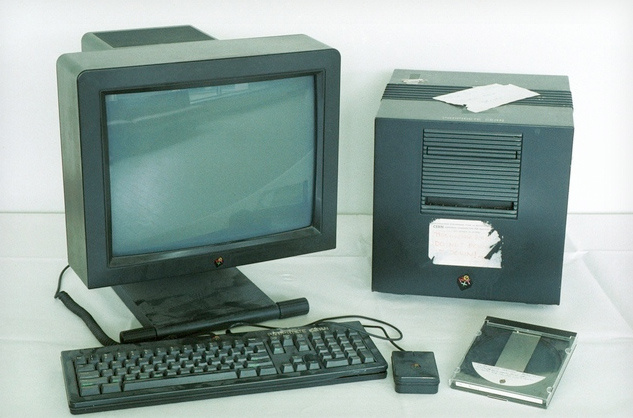
 The world?s first webpage went live on 30 April 1993 to present World Wide Web technology. The zero kilometre mark, the first ever website was a project by the Swiss institute CERN. To celebrate the 20th anniversary of the web, the institute restored the website, which can be accessed at the original address http://info.cern.ch/hypertext/WWW/TheProject.html.
The opening page containing 983 characters had twenty-five links (called hypertexts at the time), which already functioned according to modern web standards: clicking on them you could navigate between subpages.
The website was developed in 1991 by the British computer scientist Tim Berners-Lee, who has received knighthood for his achievement. Berners-Lee drew up a document that described the structure of the world wide web at CERN in 1989, then worked on the revised version with the Belgian engineer Robert Cailliau. The prototype of the 'primitive' internet was built by 1990 with a user interface that was easy to handle for anyone.
CERN's official website also presents a screen shot of Berners-Lee's original browser, which also functioned as a website editor. The fact that the web or a similar solution did not conquer the whole world as a standard developed by IBM, Microsoft or Apple is thanks to Berners-Lee's team and the decision CERN brought twenty years ago. CERN had made software systems available earlier as well, but only to researchers and educators. Cédrus, the first computer system which was developed at Hungary's Central Research Institute of Physics (KFKI) in 1976-79 also originated from CERN. The decision about the web in 1993 went much further: anyone, not only researchers, could use the web and contribute to its development.
Berners-Lee's computer is a permanent exhibit at CERN's exhibition Microcosm. You can still see a partly peeled of label on it with a warning written in red ink: 'This machine is a server. DO NOT POWER IT DOWN!'