
 The PC revolution was prevalent in1987, just like in the computer science of the entire decade. Desktop PCs became standard hardware for home enthusiasts, companies, government agencies, computer labs, and higher education campuses in the United States. Apple was working on new versions of Macintosh at full speed, and sold some of its products at discount price to schools so that students would get to know the firm better and like it more. Some futurologists and computer science experts were already trying to envisage a new generation of computer devices to come in the next 15 years, and their visions did not include traditional PCs.
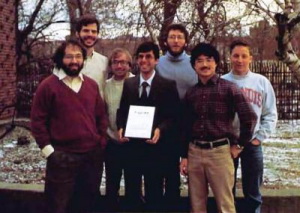
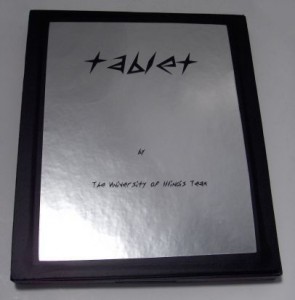 Apple did something else too in 1987: it sponsored The PC of the Year 2000 competition. Participants were asked to design the prototype of the machine that would be dominant in the year 2000. The jury was made up of renowned personalities: sci-fi writer Ray Bradbury, futurologist Alvin Toffler, Alan Kay, a pioneer in object-oriented programming and designing graphic user interface, Diane Ravitch, well-known education policy analyst, and Steve Wozniak, co-founder of Apple. This jury selected the winner from the prototypes produced by one thousand students working in teams of five. The submission by the group from the University of Illinois at Urbana-Champaign (UIUC) came in as the winner. It was named by its creators “Tablet: Personal Computer of the Year 2000″, and the prototype is now part of the collection of the Computer History Museum in Mountain View.
Tablets were not a completely new concept even back then, its genealogy can be traced back to a RAND device from 1963. The UIUC machine bore little resemblance to ancestral devices seen in sci-fi movies, for instance to the ones featured in Star Trek, while much closer resemblance to Alan Kay’s Dynabook concept from 1972 can be perceived. (“The best way to predict the future is to invent it,” Alan Kay once noted.)
The over twenty pages long description submitted by the UIUC team actually did not forecast the state of the art of the year 2000, but it fits the year 2010 almost perfectly. For its major part, the description may as well be applied to iPads, and the potential applications foreseen by the team were far from being outlandish ideas either. However, the stylus, the primary input tool envisaged, did not work out in reality.